
Variable Star Quilt


Subject
Title
Date
Format
Description
This quilt is a kaleidoscope of printed calicoes produced in the second quarter of the nineteenth century, prior to the invention of synthetic dyes. It was donated by a local family, the Gardners, who lived in Exeter, an area near the University which today is still remarkably rural.
The overall design is based on a pattern known as “variable star” which can be seen in some of the blocks where the hues and values of the colors are distinct enough to make out the pattern. One well-established method of printing calicoes at this time was block printing, where printers stamped the cloth with carved wooden blocks. Here we see a typical block print where the colors don’t quite match up with the motifs, resulting in what is called “poor registration.” Block printing was time consuming because it required multiple repetitions of dipping a block in the printing paste, wiping off the excess, and then lining up the block and stamping the cloth. Additional steps might be required depending on the colors desired. A faster method of printing became widespread in the second quarter of the nineteenth century during which many of the fabrics in this quilt were manufactured, and this method was called cylinder or roller printing. Instead of blocks, engraved cylinders transferred the chemicals onto the fabric. As many as fourteen cylinders were in use by the middle of the nineteenth century in New England’s leading print works.
Popular colors of this period include pinks, reds, and browns that were obtained by dyeing the fabric with the roots of the madder plant. Depending on the mordant – a chemical that fixed the dye to the cloth – a wide range of colors could be obtained from pale pink to barn red to chocolate brown. The mordant was printed on the fabric, and then the cloth was submerged in the madder dyebath to obtain the color. These prints are known as “madder prints” and Rhode Island companies such as Allen Print Works manufactured many madder prints. Turkey red was another popular color obtained by combining madder with oil and an aluminum mordant to produce a highly colorfast red dye.
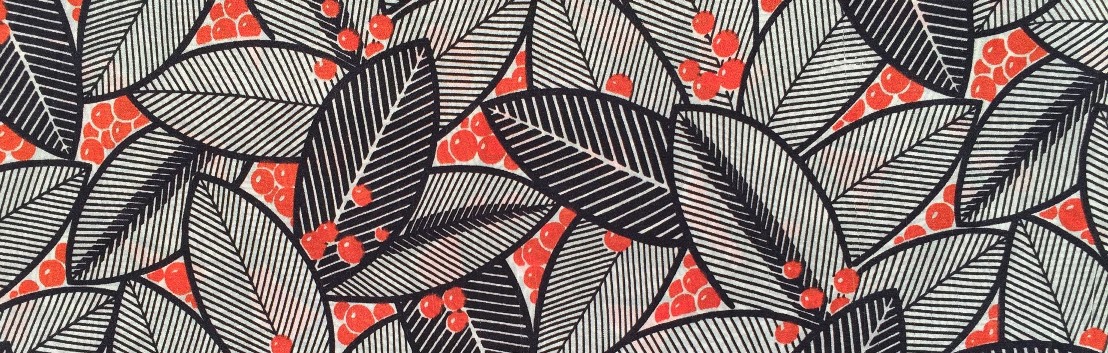
Another printing style was the discharge print, where a solid-dyed fabric was printed with a chemical that removed the dye. The berry-colored print seen here is a discharge print. A related style, known as resist printing, involved printing a substance that blocked the dye prior to dyeing. The many blue-and-white prints dyed with indigo seen here are also examples of resist and discharge prints. At this time dyers experimented with mineral colors to obtain bright yellows, of which there are several examples on this quilt. Sometimes discharge prints were “illuminated” with chrome yellow. Another bright color seen here is green. There was no single dyestuff that produced green at this time, so dyers obtained the color by dyeing blue over yellow.
The reverse of the quilt reveals another interesting fabric known as a “pillar print.” Pillar prints had been popular for bed hangings during the Neoclassical period when motifs evoking ancient columns were common. Often hangings were recycled as quilt backs, especially if the fabrics were faded and no longer useful as bed curtains.